Literacy in Ancient Israel


Although Israel was a small nation in comparison to many of her neighbors, the people of Israel enjoyed a much higher literacy rate. In fact, it is probably correct to describe ancient Israel as “literate,” something that could not be said for the populations of Egypt or Mesopotamia. Why was this the case?
The simple answer is that the writing systems of Egypt and Mesopotamia were cumbersome, complex, and much more difficult to learn. This made them the provenance of an elite few, mainly scribes. As an example, an Egyptian scribe was required to master about 800 different signs in order to read or write. Scribes in Mesopotamia who wished to read or write in Sumerian, Elamite, or Akkadian had to master roughly 900 cuneiform signs for any one language. Because of the difficulty of memorizing and working with so many signs, “the number of literati [in Egypt and Mesopotamia] probably never exceeded 2-5% of the population at any given time” (Demsky 1990: p. 11).
The Israelites, on the other hand, adopted the alphabet for the Hebrew language. The alphabet required the memorization of only 22 signs in order to read or write, something even a child could do in a fairly short amount of time. In addition, Israel’s religious system centered around a covenant and laws that existed in written form (the Torah), and this seems to have provided further reason for regular people to become literate.
Incidentally, the alphabet was invented in or around Egypt in the 19th century BC by someone who spoke Hebrew or a closely related language. Aside from the obvious borrowing of signs, “Certain Hebrew words designating writing implements and media were borrowed from the Egyptian language during the New Kingdom (1549–1069 BCE), which suggests that the Hebrew scribal culture was basically borrowed from Egypt” (Richelle 2026: p. 17).
Over time the use of the alphabet spread to other languages, including not just Hebrew but Phoenician, Ugaritic, Greek, Latin, German, Spanish, English, and other western languages. Ironically, the Egyptian language did not make use of an alphabetic script until Coptic (a variation of the Greek alphabet) in the 1st century AD, when the alphabet had already been in use elsewhere for almost 2,000 years.
The evidence for literacy in ancient Israelite comes from a number of sources, both literary and archaeological.
Literary evidence
Biblical evidence includes the literate youth from Succoth who was able to write down the names of the 77 leaders of his town (Judg 8:14, c. 1170 BC), the letter of Jezebel to the officials of Naboth’s town (1 Kgs 21:8, c. 850 BC), and David’s private letter to Joab (2 Sam 11:14, c. 990 BC). Deuteronomy 24:1 assumes a fairly high level of literacy, since anyone wishing to divorce his wife was to provide her with a written document to that effect. Texts such as Habakkuk 2:2 (“Record the vision and inscribe it on tablets, that the one who reads it may run“) and Isaiah 28:9-13 assume a literate society (Crenshaw 1998, p. 36, 91). There is also evidence from the reign of Jehoshaphat (c. 860 BC), when court officials, Levites, and priests were commissioned to teach in the cities of Judah—“And they taught in Judah, having the book of the law of Yahweh with them; and they went throughout all the cities of Judah and taught among the people” (2 Chr 17:9).
To these practical examples might be added a number of alphabetic devices in scripture that were intended to help people learn wisdom literature. A number of the psalms are acrostic, with the first letter of each phrase, line, or paragraph beginning with sequential letters of the alphabet (Ps 9, 10, 25, 34, 37, 111, 112, 119, and 145).
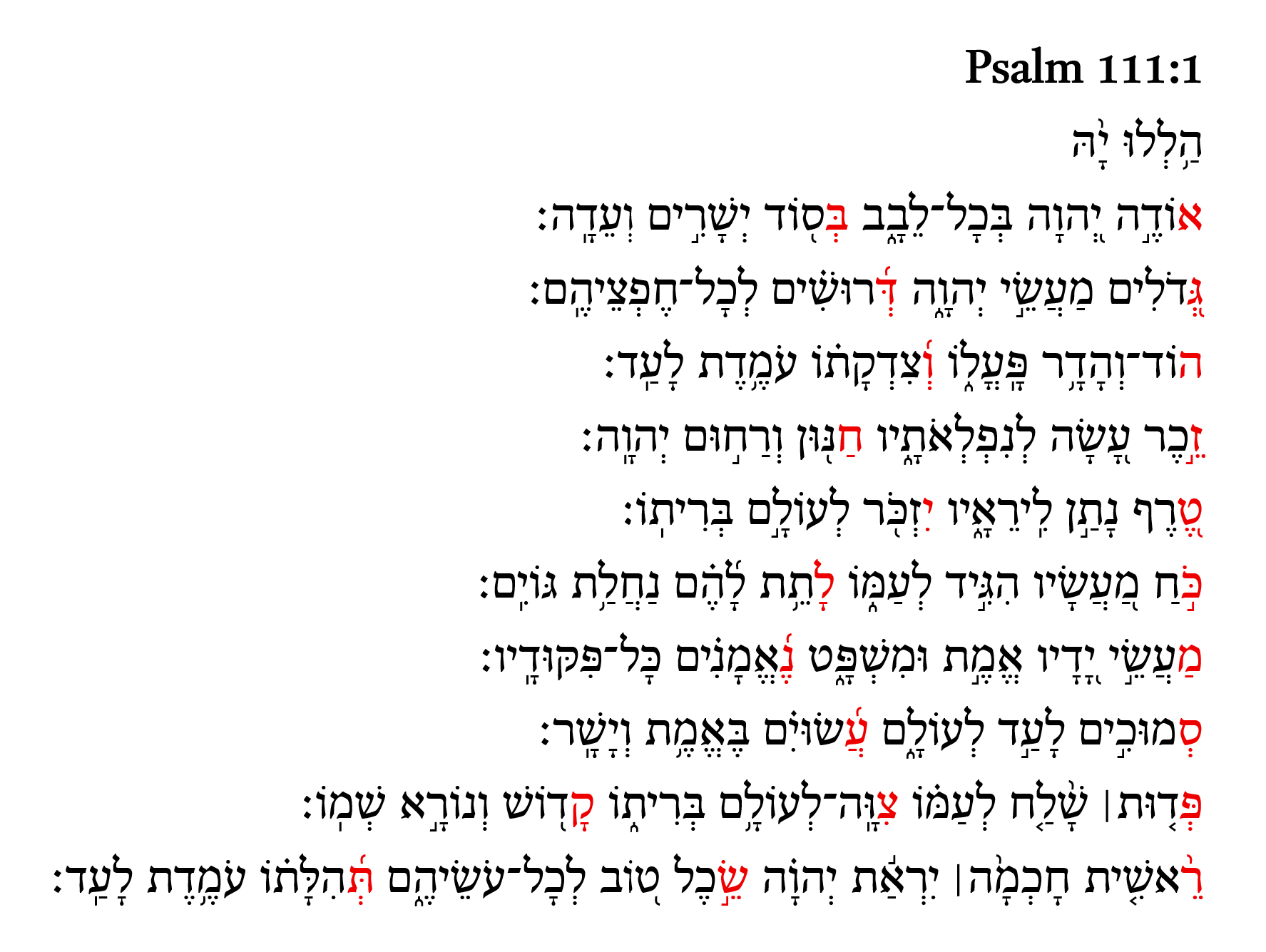
Acrostic layout of Psalm 111. Each verse has two phrases, each beginning with the next letter of the Hebrew alphabet; the last two verses have three phrases each.
A variation of this is the writing exercise where the first letter of the alphabet is paired with the last, the second with the next to last, and so forth, referred to as ’at-bš. This device was used several times by Jeremiah (Jer 25:26; 51:1, 41), who was “sure that it would be understood by his urban audience” (Demsky 1990, p. 12).
Demsky makes another important point when he observes that “in societies where literacy was limited, as in Mesopotamia and Egypt, we find only paeons to the scribe and praise for his profession. Paradoxically, in the literate societies that emerged in Israel and later in Greece, we find a critique of writing pointing out its limitations particularly in the educative process as well as in its exploitation for deceitful purposes by professional scribes (Isa 10:1-2; Jer 8:8)” (Demsky 1990, p. 16).
Archaeological evidence
Archaeological evidence supports this view of ancient Israel as a literate society. Abecedaries (lists of the letters of the alphabet) have been discovered at Izbet Sartah, Lachish, Kadesh-Barnea, Tel Zayit, and Kuntillet-‘Ajrud. Most of these were small or remote sites where one might not expect to find literacy being taught. Practice lists of letters, numbers, or words have been found at Arad, Aroer, and Kadesh-Barnea. There are similar items among the dozens of Lachish letters, and there is the calendar tablet from Gezer, which several scholars have judged to be the practice text of a child.
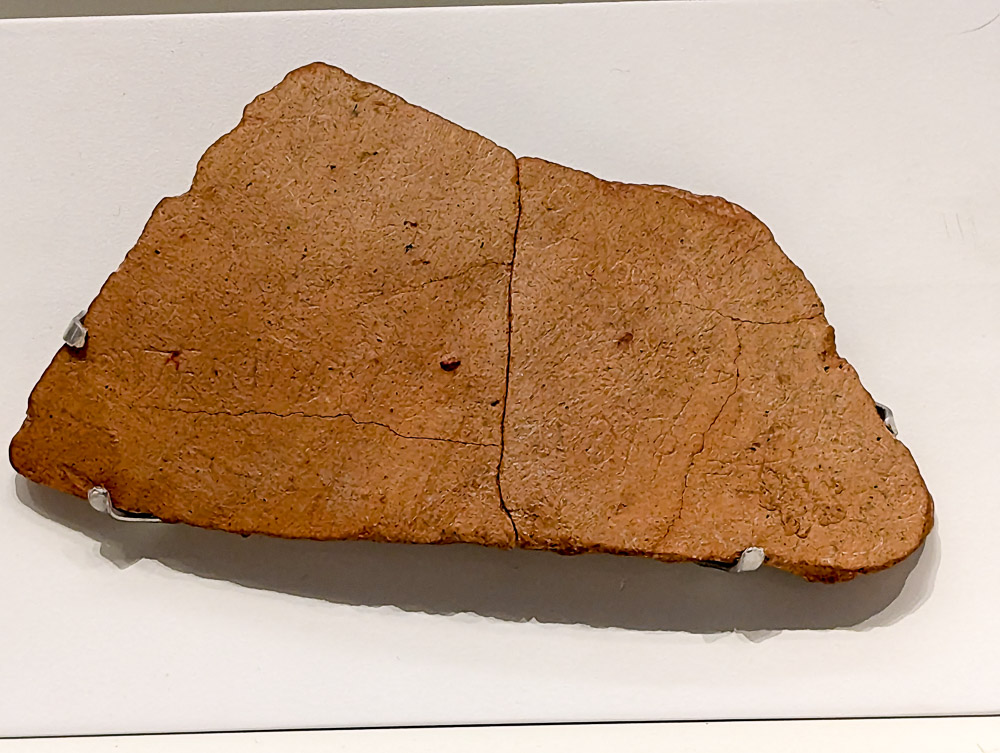
Ostracon from Izbet Sartah, Israel, 12th century BC. The inscribed letters include a line that gives the alphabet (bottom) and three lines of difficult text. Photo by Kris Udd.