

Moses and the Alphabet
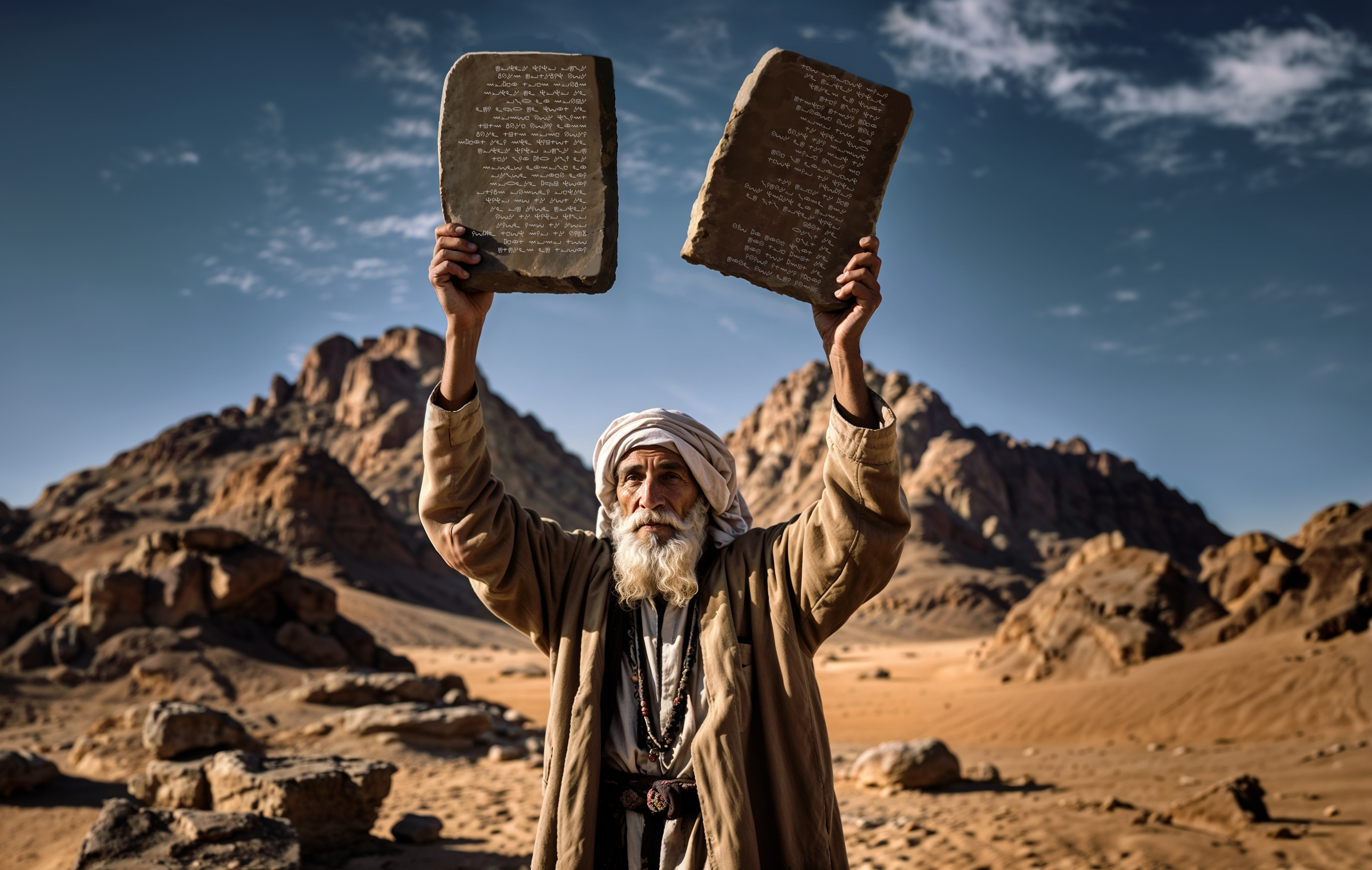

The earliest references to writing in the OT are from the time of Moses, in the book of Exodus. “Then Yahweh said to Moses, ‘Write this in a scroll as a memorial, and recite it to Joshua, that I will utterly blot out the memory of Amalek from under heaven‘” (Ex 17:14). “And when he had finished speaking with him on Mount Sinai, he gave Moses the two tablets of the testimony, tablets of stone, written by the finger of God” (Ex 31:18).
What language, writing material, and script did Moses use to write things down? What would the writing on the Ten Commandments have looked like? Or the books of the Torah that Moses wrote?
Language
Every indication is that the language of Moses and the Israelites was Hebrew, and that the first five books of the Hebrew Bible, traditionally attributed to Moses, were written in Hebrew. Since Moses was reared in the Egyptian palace he undoubtedly knew the Egyptian language. And there are occasional Egyptian loan words in the first five books of the Bible, especially in the Exodus narrative, as one would expect given the setting. But the text itself gives every evidence of having been originally composed in Hebrew.
Today many people associate the Hebrew language with the square Aramaic script that became popular during the Middle Ages, as shown below, but that is not the shape of letters that would have been used by Moses.
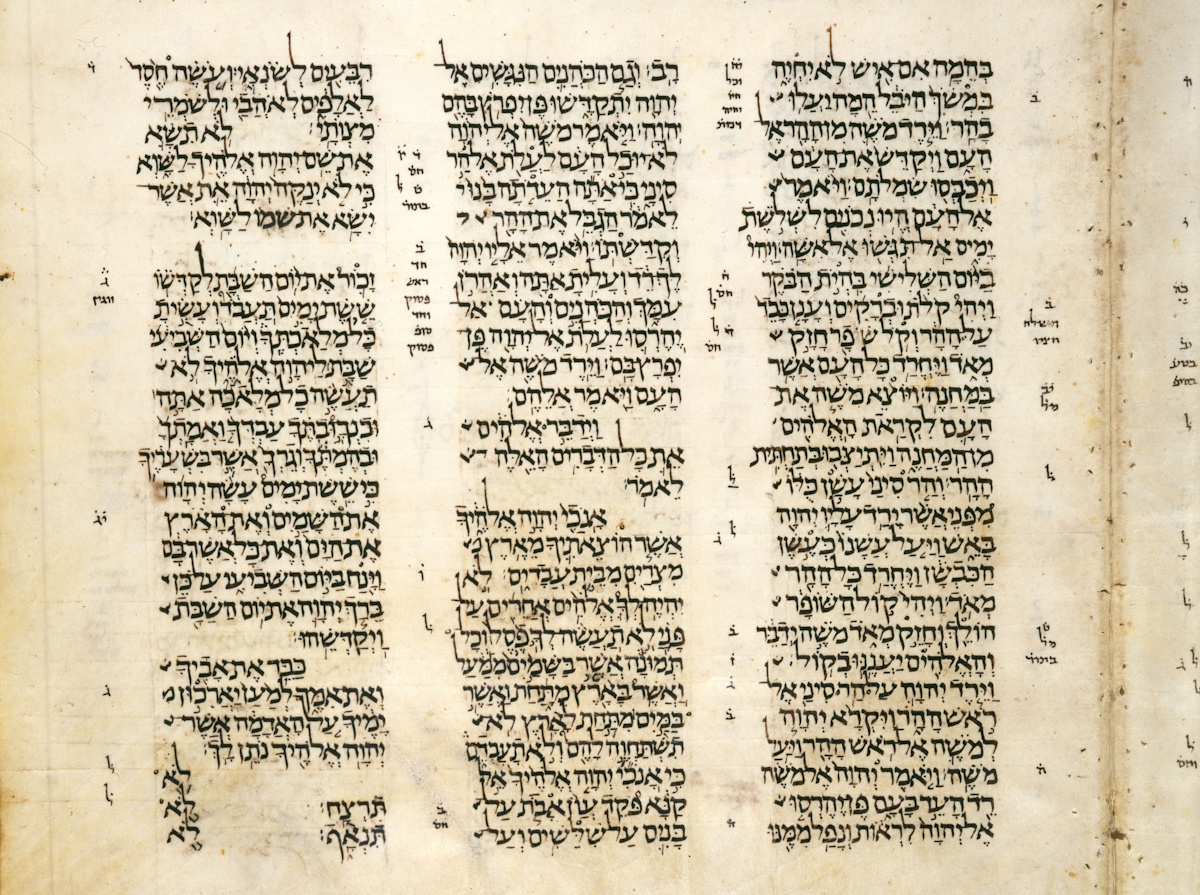
Page with the beginning of the Ten Commandments, Leningrad Codex, AD 1008. Image from Wikimedia.
Script
Hebrew is an alphabetic script. It has only 22 letters, and anyone who knows Hebrew and learns those 22 letters can read a Hebrew text. This is very different from the written languages of the surrounding empires. Egyptian hieroglyphs are a mix of pictograms and syllables, with roughly 800 signs (the number varied over the centuries). In Mesopotamia, Akkadian, which was mostly syllabic (but also had signs like determinatives) had about 900 signs, as did Sumerian and Proto-Elamite. The effort it took to master the signs required to read or write these languages was enormous, especially in comparison to the mere 22 signs needed to read or write an alphabetic script. As a result, most people were illiterate. In fact, literacy in ancient Egypt is thought to have rarely exceeded 1 percent (Crenshaw 1988, p. 40).
Moses wrote during the second half of the 15th century BC (cf. 1 Kgs 6:1). It is now known that the alphabet was invented in or around Egypt in approximately the 19th century BC (see Goldwasser 2010). It was based on Egyptian signs, but the signs were used differently. Each sign only made a single sound, rather than a syllable or an entire word, which greatly simplified the system. It was this system, known as an alphabet, that developed into the writing systems of the Hebrews and the Phoenicians (and later the Greeks and Romans).
 The image below shows a sphinx discovered at Serabit el-Khadem, an Egyptian turquoise mining site in the Sinai Peninsula. On the shoulder is an Egyptian inscription written in hieroglyphs that reads, “Beloved of Hathor, the mistress of turquoise.” On the base below it, however, is one of the earliest known alphabetic inscriptions. It reads, “Beloved of Baalat” (Heb. מאהב בעלת; but unlike modern Hebrew, to be read from left to right). This object dates to the 19th century BC, about 400 years before the time of Moses.
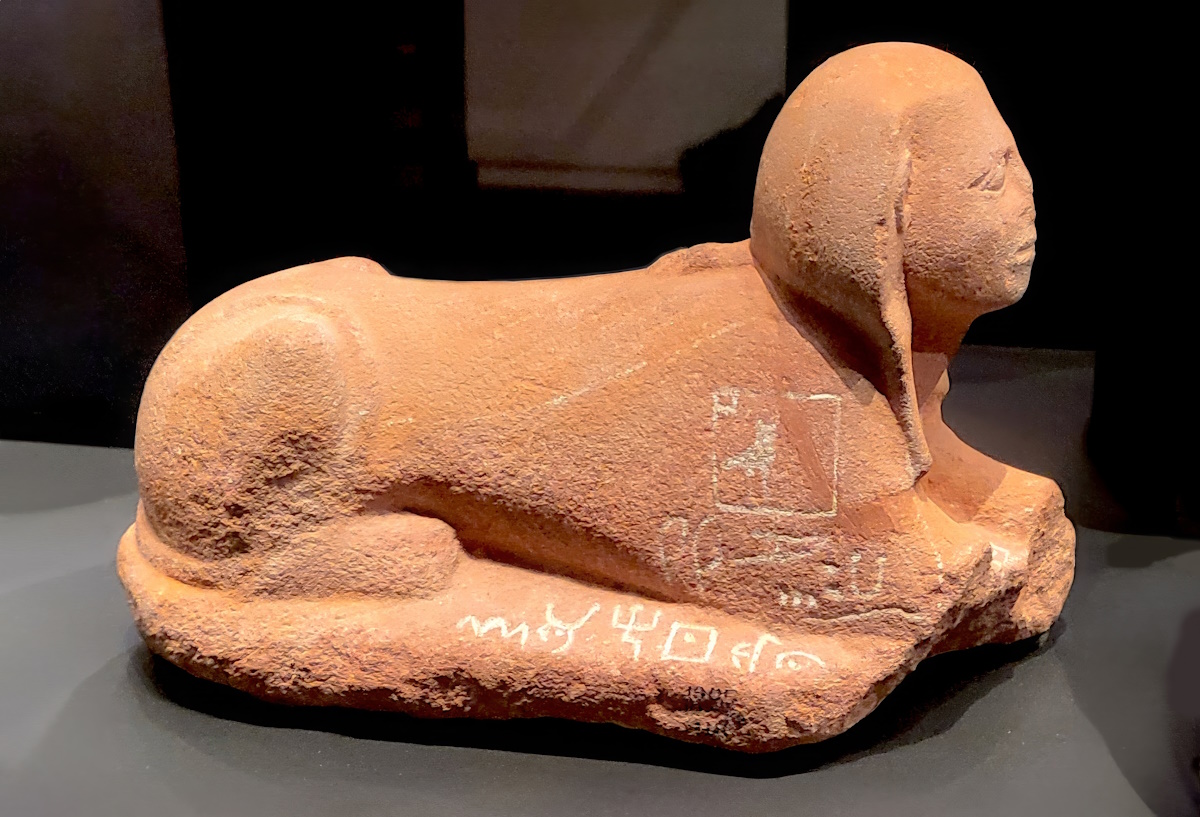
Sphinx from Serabit el-Khadem, with a very early alphabetic inscription that reads, “Beloved of Baalat.” Image from Wikimedia.
The alphabet was only invented once, but has been adopted for other language groups many times. For more on the use of Egyptian signs for the first alphabet, see the work by Brian Colless (scroll to the end for his chart of Egyptian signs that were used to create the first alphabet).
It was this script, then, that Moses would have used when he wrote. Of course, the Hebrew script of Moses’ day looked different than the later Hebrew scripts that developed during the Iron Age. But the alphabet is the same, and the shapes of individual letters can be traced from one stage to the next over the centuries.
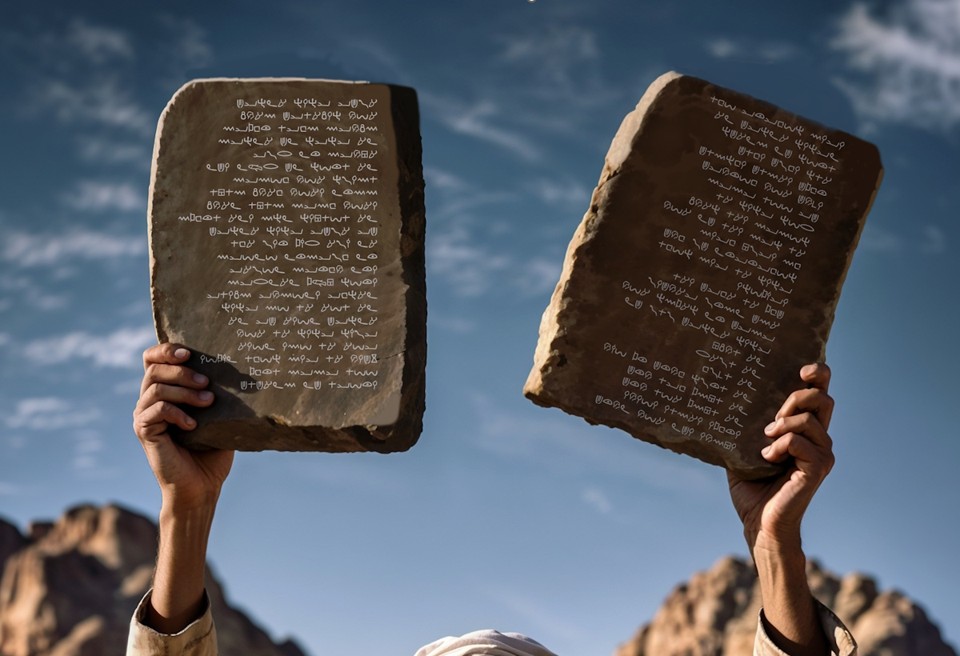
Illustration of Moses holding up the two tablets of stone, with the full text of the Ten Commandments as it would have appeared around the 15th century BC. Illustration by Kris Udd.
Writing materials
The shape of alphabetic signs, like the Egyptian hieroglyphs from which they came, work naturally with a stylus or pen, using paint or ink, on a flat surface. This may be contrasted with cuneiform, which originated in a land without papyrus or other similar writing surfaces. For cuneiform, the scribe used a tool that was pressed into soft clay rather than dragged along the surface, making wedge-shaped indentations to form signs.
The Egyptians had been using papyrus as a writing surface, along with pen and ink, since at least the Old Kingdom. In fact, a pen case that held both pens and ink was the standard equipment for an Egyptian scribe, even many centuries before the time of Moses.
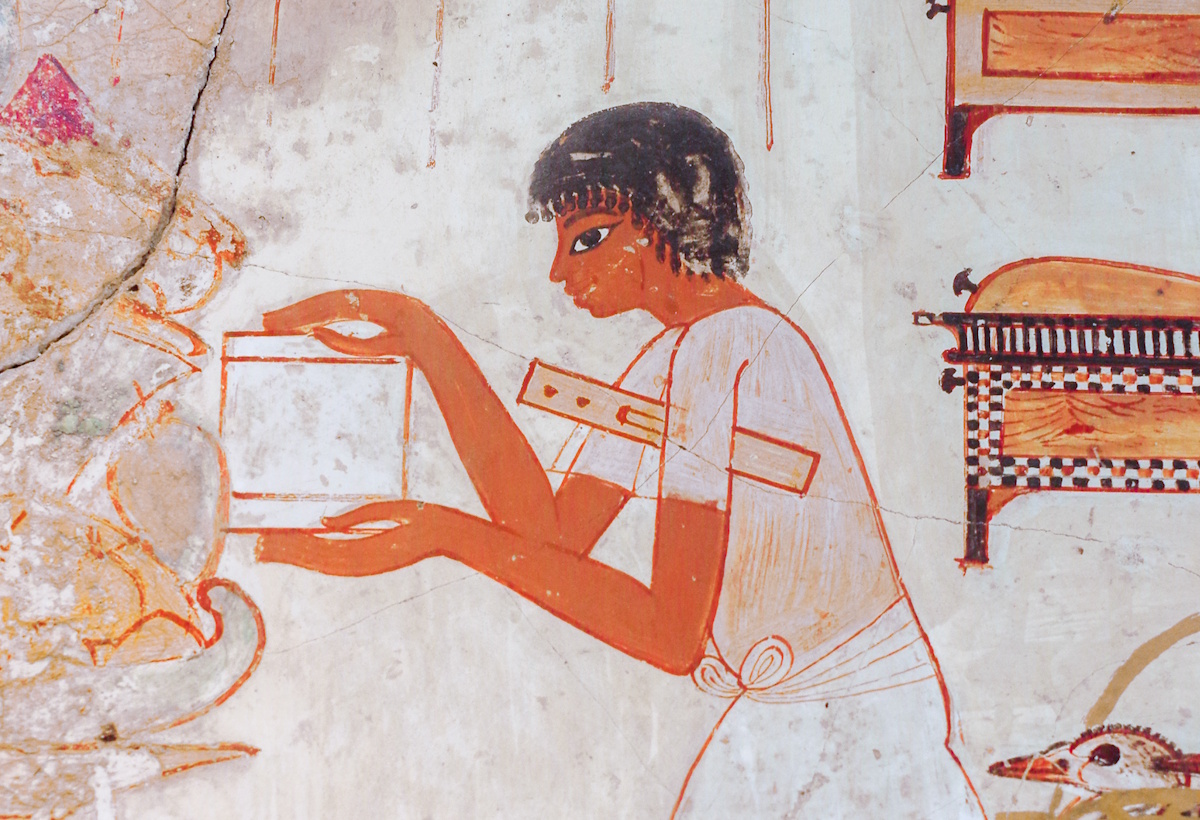
Tomb painting of an Egyptian scribe holding a papyrus roll; note also the pen case with pens and ink tucked under his arm. From the tomb-chapel of Nebamun at Thebes, circa 1350 BC. Photo by A.D. Riddle, used by permission.
Given that Moses and the Israelites had just come from Egypt (with plunder, Ex 12:35-36), it would be no great stretch to conclude that they had plenty of papyrus and writing supplies with them. So this is how we should envision Moses writing the Torah, with a reed pen and Egyptian ink, on papyrus. The pen cases shown below, each of which also has a small reservoir at the end for red and black ink, are from approximately the time of Moses.
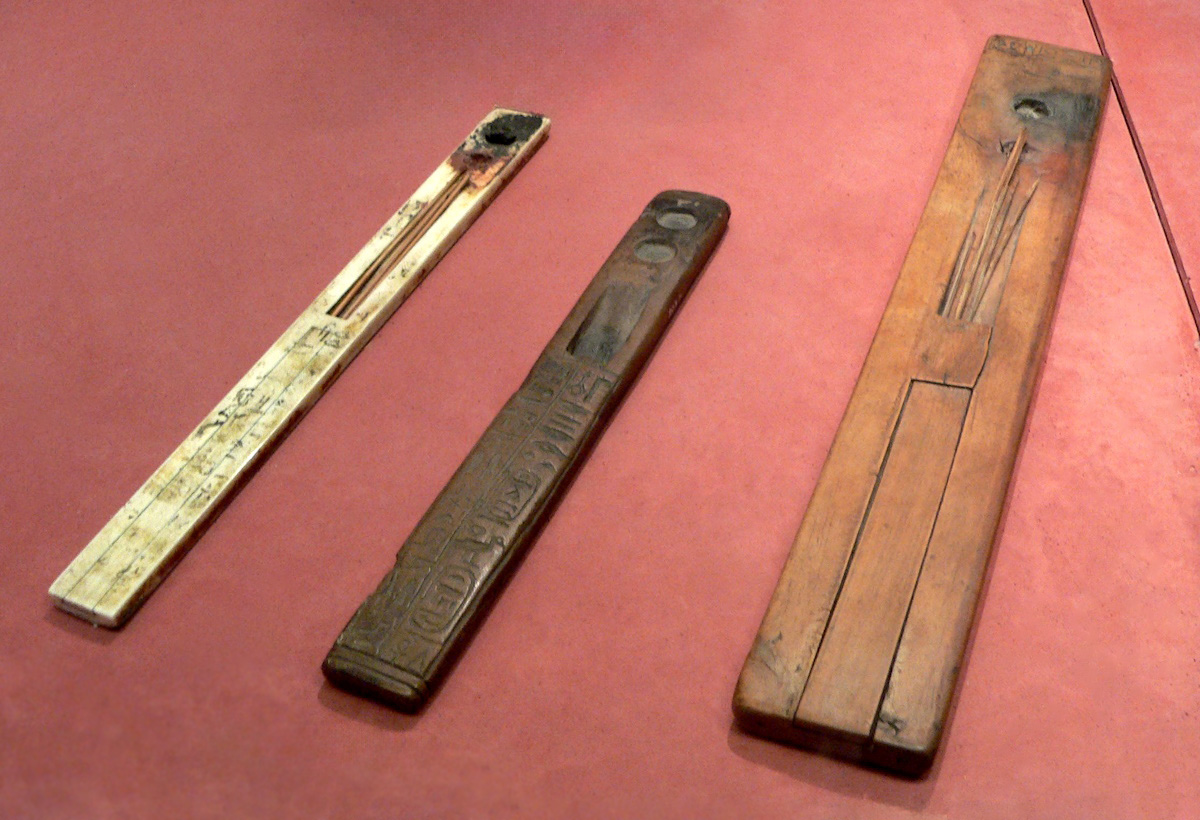
Three Egyptian pen cases with reed pens and ink reserves, circa 1550-1350 BC. Image from Wikimedia.
