

Kings of Judah and Israel: Good vs. Bad


The book of Judges anticipates a time when Israel would be ruled by a king, but what was the character of the kings who eventually ruled, first over a united kingdom and later over two rival kingdoms? Unfortunately, most were not good. The graphs below show the approximate length of reign of each, and are color coded to indicate whether they were considered good (green) or evil (red). In some cases, their character changed during their reign. On the first chart we have the kings of the united kingdom, followed by the Davidic line that ruled the kingdom of Judah.
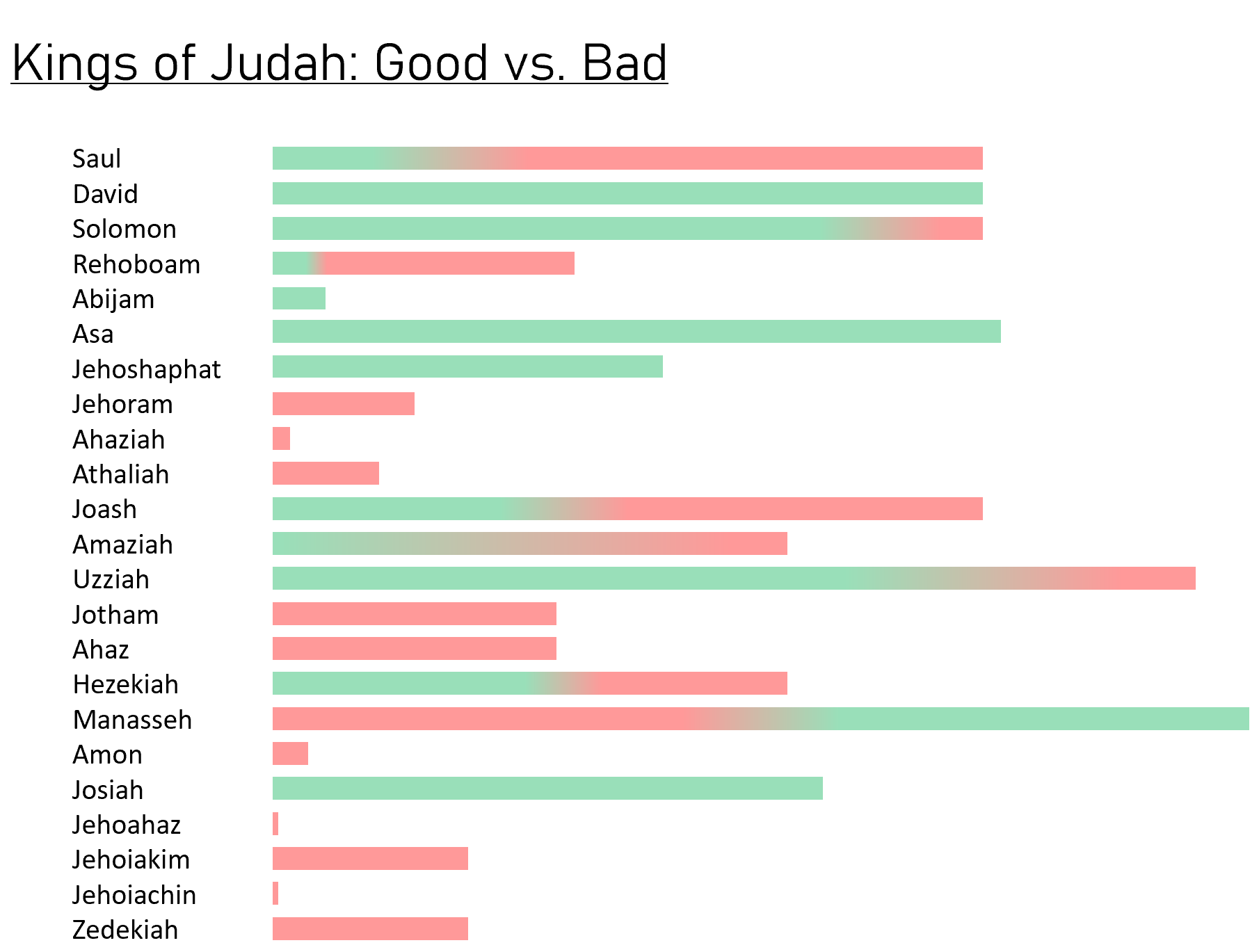
Graph of the reign lengths and moral character of the Kings of Judah.
For some of these whose character changes during their reign, the exact proportion that is good or evil (or when the transition took place) is uncertain. For example, it is known that Manasseh was an evil king, but that after being taken into captivity he repented, and God restored him to the throne (2 Chr 33:9-13). However, no indication is given as to when in Manasseh’s long reign this might have taken place, and it is even uncertain how he ended his rule (here it is assumed that it was good, but this is a guess).
The following may be worth noting: thirteen of the 23 kings began well, but of those thirteen, only six ended well; of the ten that started badly, only one may have ended well (Manasseh). The trend is clearly toward evil, not toward good.
As poorly as the kings of Judah fared, the kings of Israel were worse.

Graph of the reign lengths and moral character of the Kings of Israel, with lines dividing the various dynasties.
As can be seen, the kings of Israel were almost entirely evil. Each of the three green sections that appear on this chart are worth explanation.
1) Jeroboam I is allowed a brief initial period of good due to the fact that God chose him as the first king of the northern kingdom and promised him a lasting dynasty if he would remain faithful (1 Kgs 11:26-39). This is based on the assumption that God would not have made such a promise to someone who was already sold to do evil.
2) Ahab is unique in a number of ways. The description of his reign is lengthy, in part due to his numerous dealings with Elijah, for whom he seems to have had some respect. His evil actions in numerous cases were instigated by his evil wife, Jezebel (e.g. her support of Baalism, her plot to murder Naboth, etc.). “Surely there was no one like Ahab who sold himself to do evil in the sight of Yahweh, because Jezebel his wife incited him” (1 Kgs 21:25). The green mark on Ahab’s record is intended to reflect his repentance when he was confronted for the final time by Elijah (1 Kgs 21:16-29). God said, “Do you see how Ahab has humbled himself before me? Because he has humbled himself before me, I will not bring the evil in his days, but I will bring the evil upon his house in his son’s days.” (1 Kgs 21:29). It is not clear what exactly this repentance meant, or whether it was lasting, but it is at least represented on the graph with a small green section.
3) Jehu was the one who wiped out the house of Ahab. He did so at God’s direction, and he also eradicated the worship of Baal from Israel, at least for a time (2 Kgs 10). “And Yahweh said to Jehu, ‘Because you have done well in executing what is right in my sight, and have done to the house of Ahab according to all that was in my heart, your sons of the fourth generation shall sit on the throne of Israel‘” (2 Kgs 10:30). However, this good beginning did not last. “But Jehu was not careful to walk in the law of Yahweh, the God of Israel, with all his heart; he did not depart from the sins of Jeroboam, which he made Israel sin” (2 Kgs 10:31). So it appears that the latter part of his rule could not be characterized as good.
For those who may be interested in more exact dates for the kings of Israel and Judah, and who was contemporary with whom, the following chart may prove helpful.
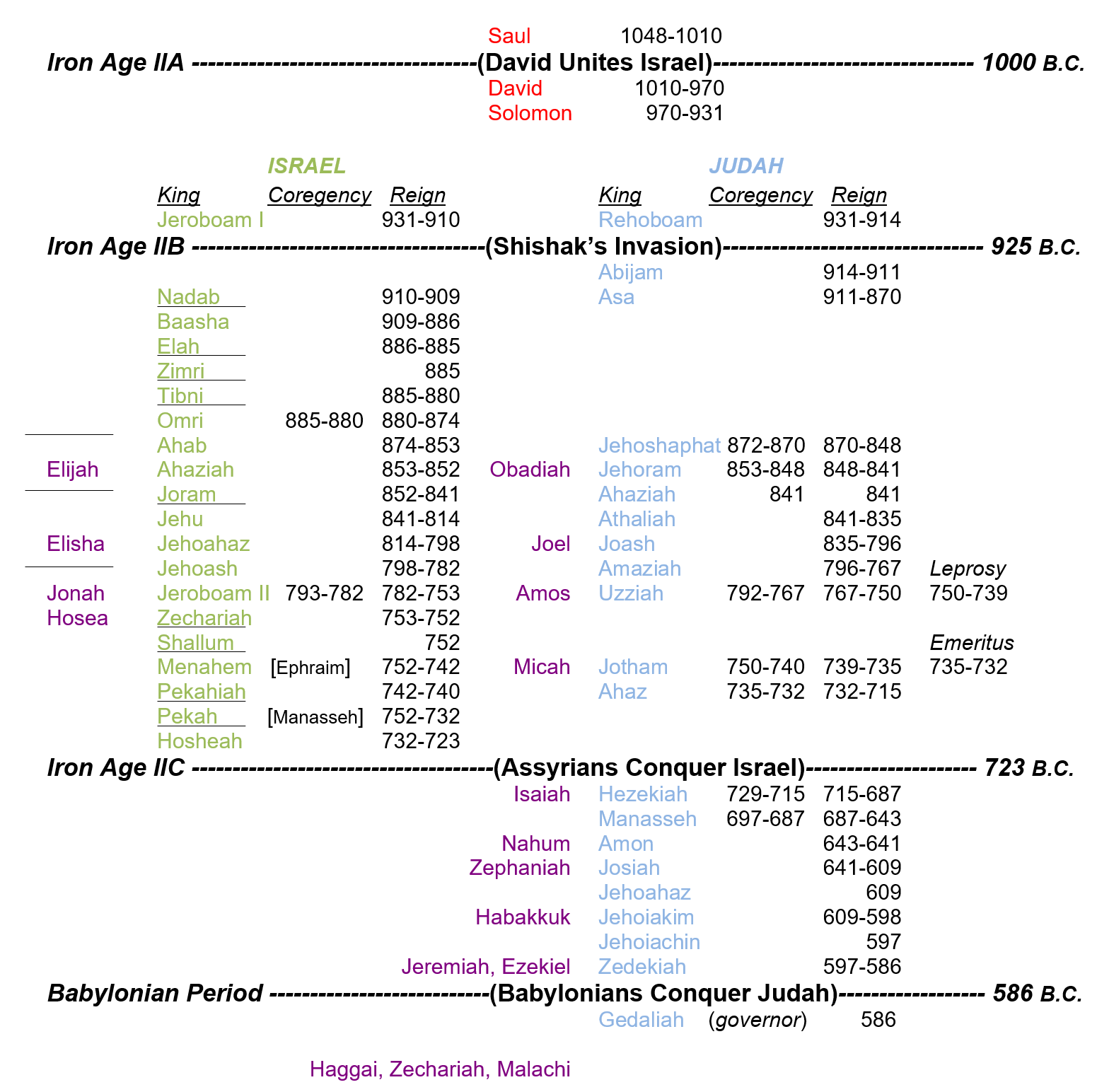
Chart of the Kings of Israel and Judah, modified from the work of Edwin Thiele.

Great perspective.