

Daniel in the City of Susa


Daniel’s vision in Daniel 8 is set in a distant city, Susa. Susa was in Babylonian territory, but on the very eastern edge. It was about 225 miles from where Daniel most likely had the vision, Babylon. Although some believe Daniel may have actually been in Susa at the time of the vision, the text allows that he may have only been there in his vision. “And I looked in the vision, and it came about while I was looking, that I was in the citadel of Susa, which is in the province of Elam” (Dan 8:2, NAS).

Map of the distance between Babylon and Susa (about 225 miles).
Daniel further specifies that he was “beside the Ulai Canal.” Some older versions take this to be the Ulai River (KJV), but the word (uval, אוּבָל) is not the normal word for a river (nahar, נָהָר). What Daniel seems to be referring to is the (now dry) canal that separated the royal city at Susa from the lower city. That canal performed two functions. It provided water into the heart of the city, for both the royal residence (the “citadel”) and for the lower city; it also formed something of a barrier that protected the royal city on its eastern side.
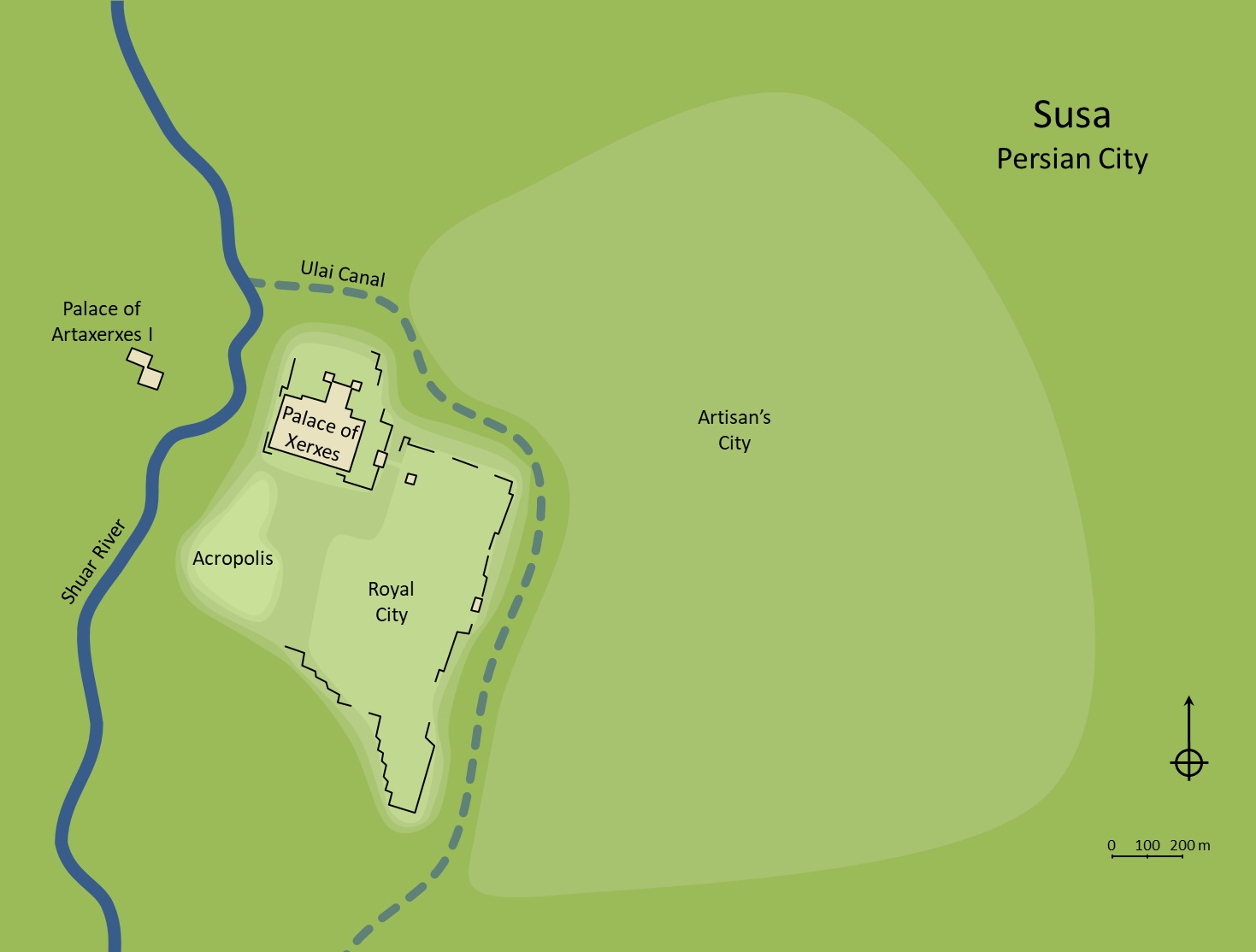
Plan of the Ulai Canal in the city of Susa.
The canal likely silted up and filled in fairly quickly once it was no longer maintained. Today it is just a dry depression between the Royal city and the much larger lower city.
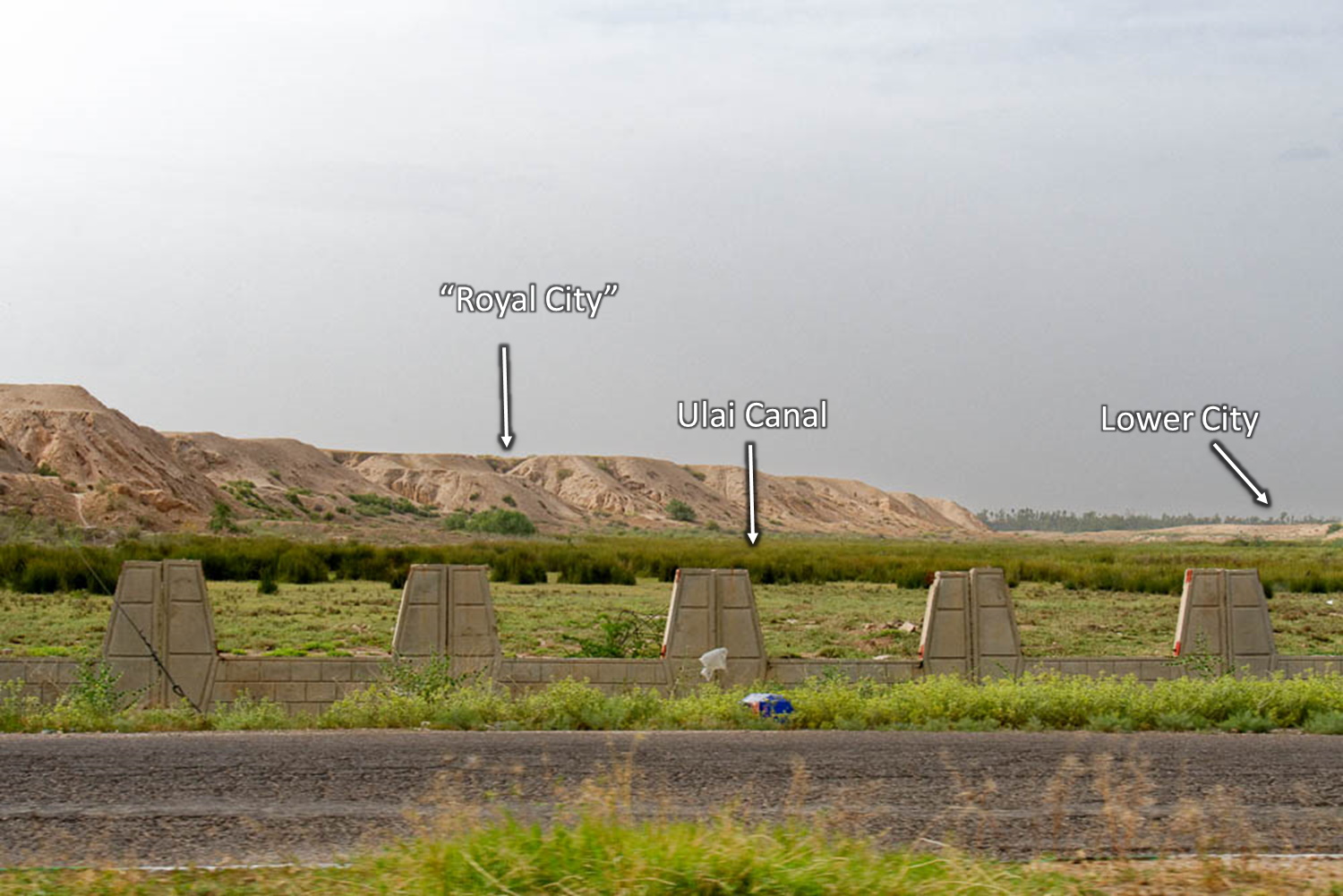
Photo of the Ulai Canal, taken by Todd Bolen in 2018.
Why did this vision take place in Susa, and not in the Babylonian capital? Perhaps because the first part of the vision relates to the Medo-Persian empire. It also has an intriguing connection to Esther, about 70 years later. Does it anticipate that book?

I appreciate your explanation of the geographical detail.
This is really neat!!!
I am leading a study on Daniel/Esther and this is so helpful. Your images and insight help me visual and put the events and timeframe into perspective to help lead my women. God has gifted you! Glad I stumbled upon your blog.
This is very helpful. True, the word translated as “river” is not the typical translation. My question is with the word הַבִּירָה. This is commonly translated as citadel, fortress, palace or castle. Yet Strong’s H1002 also lists “temple” as a possible interpretation. I’ve been looking for more detailed information based on the entry made here: “The circumference of Shushan during its prime seems to have been about six or seven miles, and on the right bank of the Ulai stood a temple or observatory, whose remains are now called Tell-i Sulaiman (“Hill of Solomon”), and other structures.” [https://www.jewishencyclopedia.com/articles/13621-shushan]. Since Chapter 8 will give details to the temple in Israel, I was wondering if we may have missed an opportunity to correctly translate the word “citadel” to temple. If it was located on a high place, Daniel might have had a full view of the kingdom to come.
Its an interesting question. I would make two observations in response to your suggestion. The first is that the only temple in Susa would be a pagan temple. That begs the question of what Daniel would have been doing there, in the house of a false god. I think that question is difficult to answer regardless of whether he was there in person or in a vision. The second point is that this exact phrase, “in Susa the capital” or “in the citadel of Susa” (בְּשׁוּשַׁן הַבִּירָה) appears ten times in the book of Esther (1:2,5; 2:3,5,8; 3:15; 8:14; 9:6,11,12) and it is quite clear from the context in Esther that a temple is not in view. Remains of an earlier temple (12th century BC, six centuries earlier than Daniel) have been found on the acropolis at Susa (see here), but a connection between Daniel and a pagan temple at Susa seems unlikely.
Why is it difficult to answer why Daniel found himself in a pagan temple? It was a vision shown to him by the Lord. He was either there in spirit or translated there physically, but either way, it was significant to the context of his vision.
Perhaps late to the party here and first time so you may have further posts I am not aware of, but I will lay down at least a scratch upon the surface of what this might be about. The whole eschatological world believes that Daniel 8 is about the rise of some future antichrist, but I posit that the location of the vision is by no means trivial. Susa is where the so-called antichrist came from. Literally, the Prince of Persia or Wormwood who was thrown out of heaven and is worshipped on earth as Mithra in the day of Artaxerxes (who invoked Mithra on the columns of his temple) and continued to be worshipped as Mithras in the Mithraeum of Roman Mithraism. To understand this, you have to follow the Royal Road from Susa to Sardis where the letter to Sardis in Revelation described their works not complete…whose works? The protestant priests of Mithras. Well, probably said too much but yeah, if you are looking at the scriptural significance of Susa you might just be on the right track. You might be interested in 3 Enoch 35:12 that tells us that historically the Prince of Rome and the Prince of Persia sat with Satan detailing the sins of Israel and sent them up through the Seraphim to the Holy God. So, what then is the probability that the pagans of Rome would adopt a Persian deity? Things that make (well at least me) go hmmmm?
Randy, thank you for the post. It does seem to me that you make a number of assertions that lack evidence. 1) The identification of the “Prince of Persia” (Dan 10:20) with “Wormwood” (Rev 8:11) and with Mithra; 2) the identification of “the protestant priests of Mithras” as the problem at Sardis (Rev 3:1-6), particularly since none of those words appear in that text; in fact, he urges them [lit. “you”] to complete their works, so how could this refer to Mithraism? 3) the assertion that 3 Enoch provides “historical” information. All three of those appear to me to be logical leaps that lack evidence of any kind. I also wonder if there isn’t some confusion here chronologically. You are correct that Artaxerxes (specifically, Artaxerxes II) appears to have worshiped Mithra, but he is the earliest known example, and he comes more than a century after the time of Daniel. Also, the Romans certainly did adopt Persian deities, just as they adopted Egyptian deities (e.g. the temple of Isis at Pompeii), but this was many centuries after Daniel, and it is not obvious how this leads to the conclusion that Mithras or Mithraism should be identified with the antichrist, or with the specific cities of Susa or Sardis.